
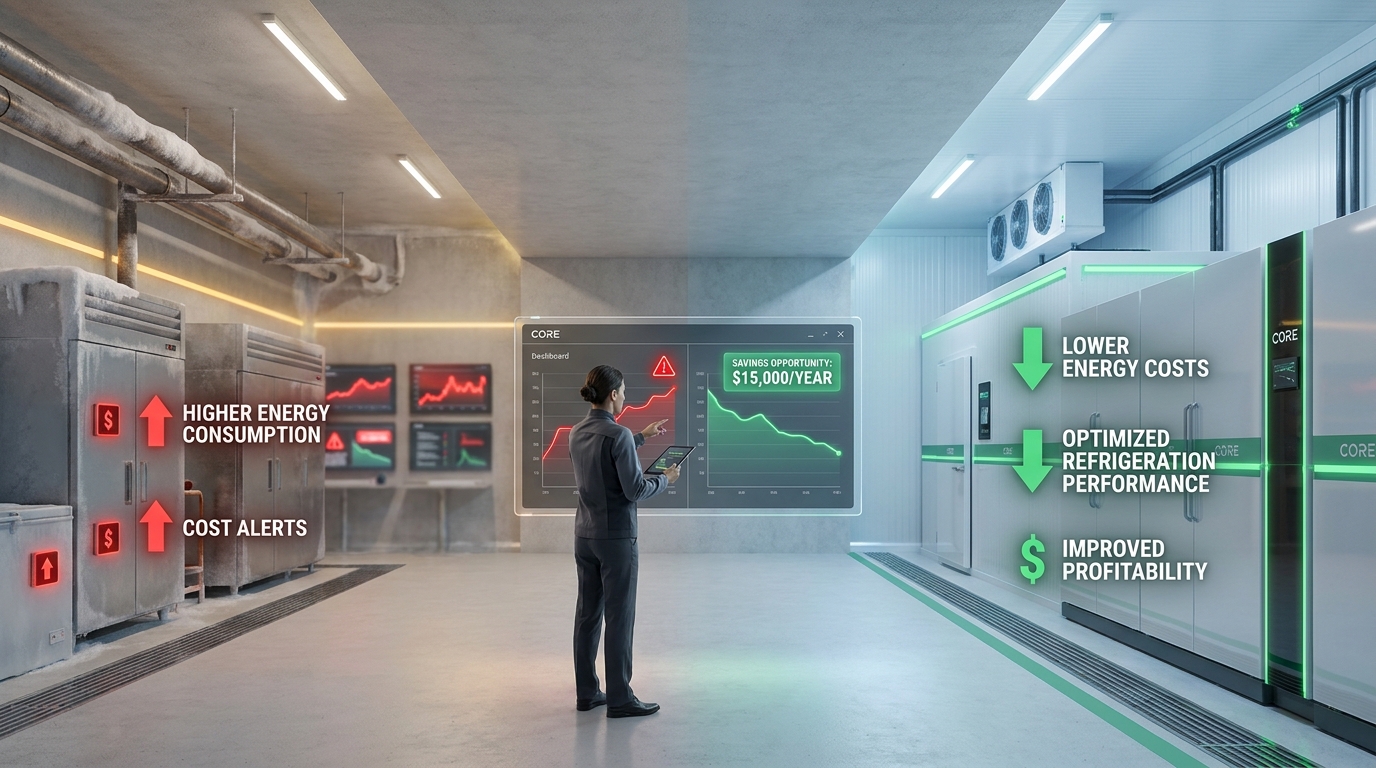
Energy is one of the largest controllable costs in cold storage — and most operators have no idea how much they’re overspending. Here’s where the losses happen, and what to do about them.
Ask most cold storage operators what their biggest expenses are, and they’ll give you the expected answers: labor, maintenance, insurance. Energy comes up — but rarely with the specificity it deserves.
That’s a costly blind spot.
In cold chain operations, energy — primarily refrigeration and climate control — typically accounts for 30 to 50 percent of total operating costs. For many facilities, it’s the single largest controllable expense. And for most, it’s also the least well-understood.
The operators who have taken the time to measure, monitor, and optimize their energy usage don’t just save money. They build a financial profile that lenders and clean energy investors actively want to fund. Those who haven’t are leaving both money and opportunity on the table every month.
Why Energy Costs Run High in Cold Storage
Cold storage is inherently energy-intensive. Maintaining precise temperatures around the clock — especially in older facilities — demands continuous mechanical effort. But there’s a difference between the energy a facility has to use and the energy it actually uses.
That gap is where most operators are losing money.
The Most Common Sources of Energy Waste
- Aging and inefficient refrigeration systems are the largest single contributor to energy waste in cold storage. Equipment that is more than 10 to 15 years old — and the national average facility age in the US is over 40 years — often operates at a fraction of its designed efficiency. Compressors that cycle too frequently, condensers that run dirty, and refrigerants that have leaked down all drive energy consumption upward without delivering better performance. Many operators know their equipment is old but have never quantified what that age is actually costing them in monthly energy spend. Once they do, the case for replacement or upgrade becomes straightforward.
- Poor insulation and door seal integrity are among the most underestimated sources of energy loss. Every time a door is opened — or fails to seal properly when closed — the refrigeration system has to work harder to recover the lost temperature. In busy facilities with frequent product movement, this can account for a surprisingly large portion of energy consumption. Regular inspection and replacement of door gaskets is one of the lowest-cost, highest-return maintenance actions available to cold storage operators.
- Lighting systems in older facilities often still rely on fluorescent or HID fixtures, both of which generate significant heat — which the refrigeration system then has to counteract. LED retrofits in cold storage environments typically deliver energy savings of 50 to 70 percent on lighting alone, with the added benefit of reducing the thermal load on refrigeration equipment.
- Unmanaged refrigeration scheduling is a less obvious but significant source of waste. Refrigeration systems that run at full capacity during off-peak hours — when ambient temperatures are lower and the facility is empty — are working harder than necessary. Implementing simple demand controls and scheduling systems can meaningfully reduce consumption without any change to performance or product safety.
- No baseline, no benchmark. Perhaps the most pervasive problem of all is that most operators have no energy baseline to compare against. They know what they paid last month, but not whether that figure is normal, high, or actively damaging their business. Without a benchmark, there’s no way to know whether an upgrade has worked, whether a piece of equipment is failing, or whether energy costs are trending in the wrong direction.
What Happens When You Start Measuring
The impact of introducing systematic energy monitoring to a cold storage facility is almost always the same: surprises.
Operators who begin tracking energy consumption by zone, by system, and over time consistently find patterns they didn’t expect. A refrigeration unit that performs normally during the day but spikes at night. A particular section of the facility that consumes disproportionately more than its size would suggest. A monthly cost that climbs steadily through summer not because of demand, but because of a degraded condenser coil.
These are fixable problems. But they’re invisible without measurement.
Once operators have an energy baseline, efficiency improvements become precise rather than speculative. You’re not replacing equipment on a hunch — you’re replacing it because the data shows it’s costing you $1,800 a month more than it should.
The Connection to Financing
Energy efficiency data doesn’t just save money. It opens financial doors.
Clean energy lenders, DFIs, and climate-focused capital providers are actively looking for cold storage facilities to fund — but they need evidence that upgrades will deliver the efficiency gains they’re projecting. Operators who have documented their energy usage, identified their inefficiencies, and quantified the improvement opportunity present a compelling, bankable case.
On the CORE platform, energy data is a core component of the CORE Score. Operators who track consumption, demonstrate efficiency trends, and document improvements strengthen their financing profile with every month of data they collect.
Facilities that have upgraded lighting, refrigeration, or insulation — and can show the before-and-after in their energy data — qualify for a broader range of financing options, at better terms, than those who cannot.
Where to Start
Improving energy efficiency in a cold storage facility doesn’t have to begin with a major capital investment. The first step is simply knowing where you stand.
An energy audit — whether conducted by a qualified provider or through basic consumption monitoring — will surface the highest-impact opportunities in your specific facility. From there, improvements can be prioritized by cost, return on investment, and relevance to financing goals.
The operators who are accessing energy upgrade financing today didn’t start with new equipment. They started with data. The data told them what to fix. The improvements told their story to lenders.
That’s the order of operations: measure first, optimize second, finance third.
CORE’s Energy Insights tool helps cold storage operators track consumption, identify inefficiencies, and build the energy data record that lenders trust. Join the waitlist and start turning your energy costs into a financing advantage.
Leave a Reply